


Stories inside stories…
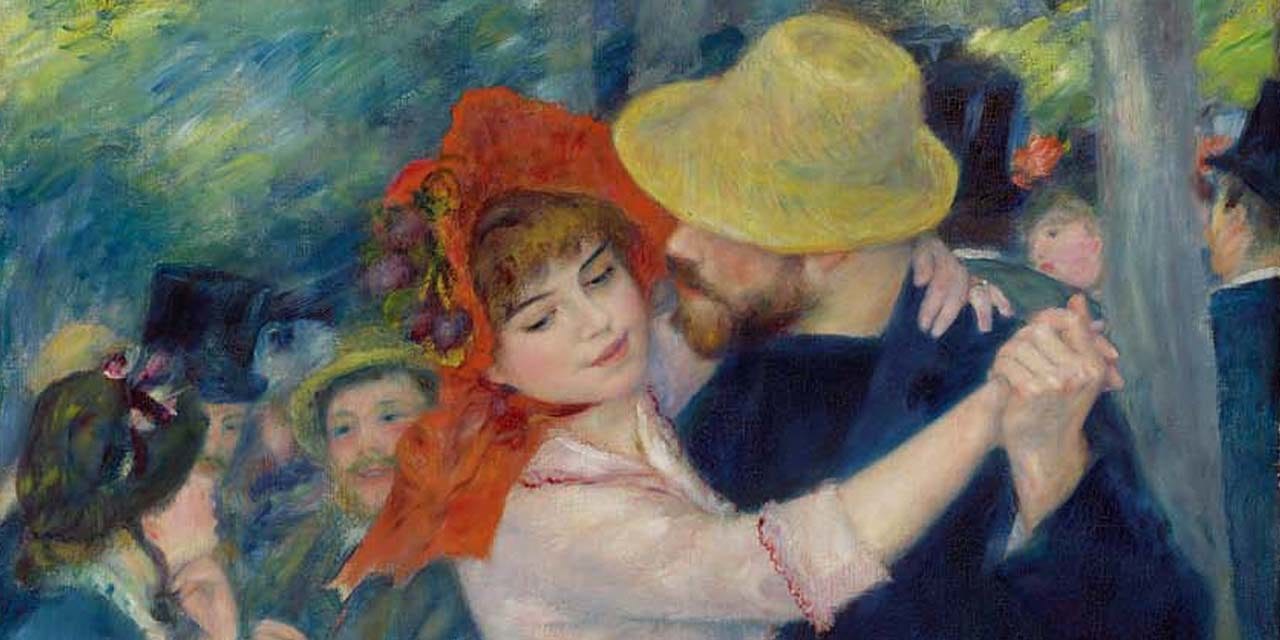
THERE ARE MOMENTS when music, painting, and story fold into each other — when a dance on canvas echoes in a novel, and a melody carries the weight of memory. In Surrendering, such a moment belongs to Denise, who watches two lovers dance and feels her own past rise within her, stirred by the strains of Debussy.
However fictional, the love story of Claude Ferrier and Marie-Rose Duchamps is deeply rooted in reality. Love stories are real — and they need to be told again and again.
This one, in particular, is rooted in art.
There is something impressionistic about the main character, Claude Ferrier, that calls to mind Debussy. And the setting is unmistakably French — not quite fin de siècle, because the twentieth century has just begun (we are in 1901), yet the atmosphere of the novel lingers in that twilight. The hotel on the Côte d’Azur, its guests, the building, the way people look and dress, their conventions and social codes — all are still very much of the fin de siècle.
I needed a scene where Marie-Rose’s friend, Denise, observes the couple while they dance. Denise is a middle-aged Frenchwoman, deeply attached to her younger friend. As she watches the lovers, she is reminded of her own great love, Grace, with whom she once visited this very place — and who has since died. As the lovers swirl around each other in the hotel’s orangerie, with musicians playing, Denise is swept into the vortex of her own love and grief. How she misses Grace. How strong, confident, and beautiful Grace was — and now she is gone. Through a mist of tears, Denise’s eyes follow the dancers. Her ears, which can no longer hear the voice of her beloved, take in the music… cello and piano interwoven.
For this scene, I had in mind Debussy’s languid, melancholy waltz: La plus que lente.
Decades after the moment in the novel, two musicians — the pianist Martha Argerich and the cellist Mischa Maisky — would become world-renowned. They traveled the globe together, always delighting in each other’s company, always making music.
Maisky arranged Debussy’s original piano piece, transforming it into a beautiful, sensual poem for cello and piano. My joy in writing this chapter was to leave their names unspoken — to let the two lovers dance, while the mourning woman is moved to tears by the music and the sight of the couple, remembering her own beloved Grace.
First: the music.
Then: the book excerpt.
Excerpt from Surrendering- Nina Rosewood. Ch22: “A Slow Waltz”
…the music changed. So did the ensemble. A different pianist and a cellist now sat on the stage. They played a slow, lingering waltz that wavered between serious classical music—to be listened to—and light salon music, meant as a backdrop for conversation or a gentle undercurrent for dancing. But the classical won out over the entertaining. A quiet, focused circle formed around the musicians, as though instead of sound and melody they were producing stillness and attention.
The cello sang. So warmly, so mournfully, so tenderly. The piano danced along, fluid and light, riding the waves of the melody. But the tones also carried something ancient, something sorrowful. Denise felt it touch her. She let herself be carried along on the tide of wistfulness.
The dancing couples had gradually left the floor two by two, becoming listeners instead. Only one couple remained, dancing the slow, sensitive waltz with deep attention. From time to time they glanced around them. But mostly, they looked into each other’s eyes. They seemed to hold one another not only in their arms, but in their gaze, as if, from their perspective, it wasn’t they who were turning, but the world around them.
Marie-Rose was dancing. She wore the light dress from the day before, the one with the red piping around the neckline, the short sleeves, and the hem. She danced on her red shoes and wore the straw hat with the ribbons. Claude wore white linen and the corduroy jacket Denise already knew.
It was clear that although he was leading the dance, his radiant partner had the true oversight, and had probably just taught him this waltz. At the same time, she had surrendered into his arms. She let herself be held as she leaned back into the movement, eyes sometimes closed, sometimes lifting again to meet his.
The languid calm of their steps, the gentle way their eyes stayed on each other—and especially Marie-Rose’s posture—told Denise that they had become a couple that day.
She sees with the eyes of her soul. You can maybe read it in gestures, in the way people move, how they hold themselves. But even then, you have to let it speak in you. You have to be willing to let it in, to really see that love is blossoming—yes, even when you’re grieving! Grief doesn’t mean love has vanished. No, it means it’s still here. That’s exactly why it hurts so much. And she and Grace... No, I should say Grace and I. Not out of politeness, but because it was Grace who brought her here for the first time. That’s how she knew this place. They danced here, the two of them, lightly, intimately. To other music, from another time, a time that hadn’t yet arrived here. And sometimes they moved a little uneasily in it, dodging small-minded judgments. Sometimes they danced a little incognito, made little concessions—by occasionally dancing with a monsieur, which could also be quite fun. Some of them were kind, or funny. And then you went back to each other, back into the dance. And now, this music, this tenderness, this couple dancing before her eyes...
How can you even see such tenderness? Isn’t that supposed to be invisible? And yet you do. You feel it. It reaches you. It stirs something, and that something begins to melt. You want to cry. Tears coming, pushing, tearing..
You don’t cry. You fight them, as long as you can. Even if you know you will lose the battle.
But something in you must remain open to this music, this tenderness. Oh, this fragile beauty, right before your eyes! You want to hear every beat, every measure of this cellist and pianist. Could they be in love, too? So tenderly attuned to one another, exchanging now and then a glance full of... something. Is it love for the music? Or for each other? Or both?
And if love is eternal, if it exists beyond time, then so does Grace’s love. That too. Her name wasn’t Grace for nothing. Oh, how full of grace she danced! How radiant she was... so timelessly beautiful, inside and out. It never stopped. How can someone be so beautiful, and then die?