

I’m not selling a book. I’m sharing what moves me.”
The sea of love is who we are. Today: grand and classical.

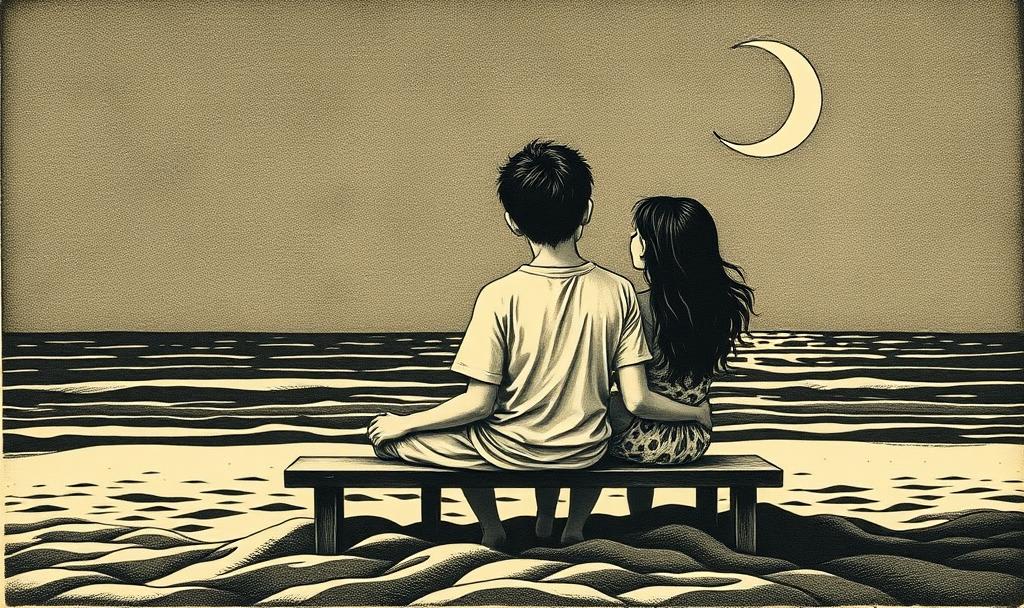
The theme of A Day Like a Thousand Years still makes me shy. Because it’s so immense.
And at the same time, it happens every day, everywhere.
The fifteen-year-old girl knows it already — even though she’s still just daydreaming.
Being in love always has to do with the whole world.
“Being in love would mean the weather’s even more beautiful, the sky even bluer, the sun even more golden. The green under the trees with their spring leaves would look even fresher. The dewdrops would be the kind you’d want to lap up with your tongue. The white and pink flowers blooming along the path — you’d tuck them in your hair. And even if it rained and the wind blew and you shivered from the cold, that too would feel more intense. And everything would smell stronger. The scents of spring and of rain. But also anything that stinks.
Being in love sharpens your senses. You might think it would make you dazed, but it’s the opposite. It wakes you up — to everything. Including what hurts, what’s ugly or brutal. Love doesn’t change reality. It amplifies it.
So real love must mean that you’ll suffer more, too. You have to be ready for that.”
That already goes far beyond romantic love. Which is why it’s an initiation.
The girl speaks as if she already knows.
But she doesn’t, Not yet.
Then love finds her. And she becomes it.
And she wakes up to the world she lives in.
Her ideals begin to form. They’ve been prepared by earlier stories of love.
She looks back. Back then, she was still just barely a child:
“She devours the great literature of the world, books so beautiful at times that they bring her to tears. Like a year ago, when she read Doctor Zhivago by Boris Pasternak for the first time. She was captivated by the timeless tenderness, the sensitivity and strength of the female protagonist, Larissa Fyodorovna. There was something ineffable, something ungraspable in it. She wanted to be like Lara, without knowing exactly what that would mean.”
The emotion was the breakthrough. And it was more than enough.
“It became the first book in her life that made her cry again and again, with long, gasping sobs. Not because she herself was sad, but because the story was so heartbreakingly beautiful. And because it was, in itself, so unbearably sad. It taught her something. It taught her how to cry for others, and how to stay light within herself. It would later become a major theme in her life, though she doesn’t know that yet.
There were a few love poems in the book that she barely understood, but which took her breath away when she saw them on the page: the words themselves, and the space between them. So much space, and the words so small and fragile. And still they could cut you in two.”
This is what she read. [Here’s the link to the book on Kobo.]

If you look up Boris Pasternak’s biography online, you’ll find the woman who likely inspired the great love at the heart of his novel. It’s all so real.
Maybe we’ve just gotten too used to stories — and people — that are fake.
But when you go looking, you still find the real ones.
And literary fiction is always built on real people.

The girl in A Day Like a Thousand Years also discovers the spacious world of Rachmaninoff — through a school friend.
“The music of Rachmaninoff, brought to her by the sensitive boy, is a gift — because those elusive moods somehow find shape through sound. The music surrounds her like a house built around her emotion. Or maybe it’s a whole park with a long drive and, in the distance, the glowing lights of a castle — for this music is expansive, vast. Rachmaninoff, after all, is as Russian as the book.”
“Somehow, the sound of one of those piano concertos has become intertwined with her bike rides through the forest on the way to the sea. The music fills her again and again with a sense of longing, merging with the cool shadows of the leafy canopy overhead as she pedals beneath it — or, on other grey days, with the slow raindrops falling on her head, her hands, her legs..”
So this witty, sensitive girl reaches for something spacious and grave, and lets her soul sing inside it.
Both the Dutch and the English version of this novel have their own soundtrack.
As a writer, you’re always a bit limited — you paint with words, and music paints otherwise.
In films it’s common practice. But in books, it’s lovely too.
I’m far from the only one who does it. The result is a soundtrack that loosely follows the chapters, filled with music from the novel’s era, because the story takes place in another time.
And today’s feeling in this post is one of grandeur and depth.
So here comes a link to an excerpt from Rachmaninoff’s Second Symphony.
If you look at the YouTube comments, you’ll see what this music means to people.
It opens. It touches. It’s chaste, and it’s a lover. It conquers, and it bows. It carries you, holds you, kisses you, lifts you.
People forget their pain for a moment.
They remember what really matters.
And no one quite knows how it does that.
The girl in the novel had already heard the music. But after the great fulfillment, it sings in her as she stands alone on a dune top in the early morning.
London Symphony Orchestra conducted by Gennadi Rozhdestvensky